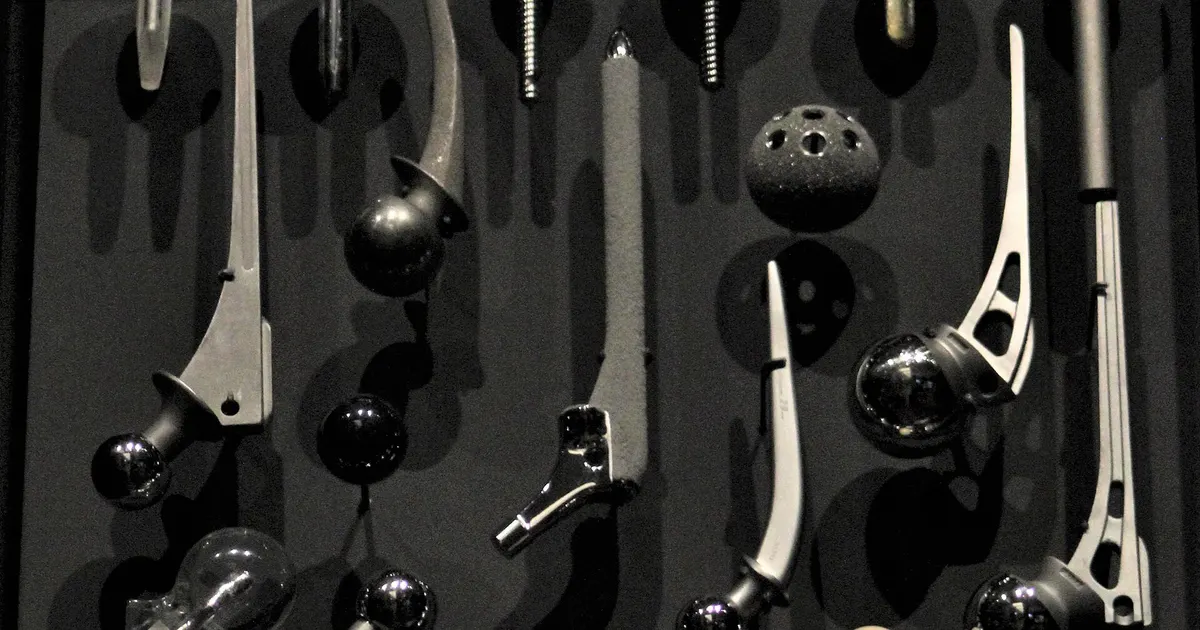
Choosing between cobalt-chrome and titanium for an orthopedic component is a design decision with consequences that travel through the whole supply chain. It sets the stiffness of the implant, its wear behavior, the biological response, the machining route, the finishing steps and the cost. Buyers sometimes treat them as interchangeable metals on a drawing. They are not.
This guide compares the two families of alloys from the machining and sourcing side. It explains where each is used, how the properties differ, what the standards are, how they cut and finish and how the choice shows up in a quote. The alloy selection belongs to the device maker, based on its design and its regulatory plan. The sourcing service reviews drawings and matches them to shops, and does not recommend an alloy for any implant.
The two alloy families
Cobalt-chrome-molybdenum alloys contain mostly cobalt, about 27 to 30 percent chromium and about 5 to 7 percent molybdenum. They are hard, strong and highly resistant to wear and corrosion. Common implant specifications include ASTM F75 for cast alloy, ASTM F1537 for wrought alloy and ASTM F799 for thermomechanically processed alloy.
Titanium alloys for implants include commercially pure grades and Ti-6Al-4V ELI, covered by ASTM F136 for wrought bar, and other alloys that are designed to be free of aluminium and vanadium. They are light and strong, and the metal forms a stable oxide that bonds well with bone.
Properties compared
| Property | Cobalt-chrome-molybdenum | Titanium alloy (Ti-6Al-4V ELI) |
|---|---|---|
| Density | about 8.3 to 8.8 g/cm³ | about 4.4 g/cm³ |
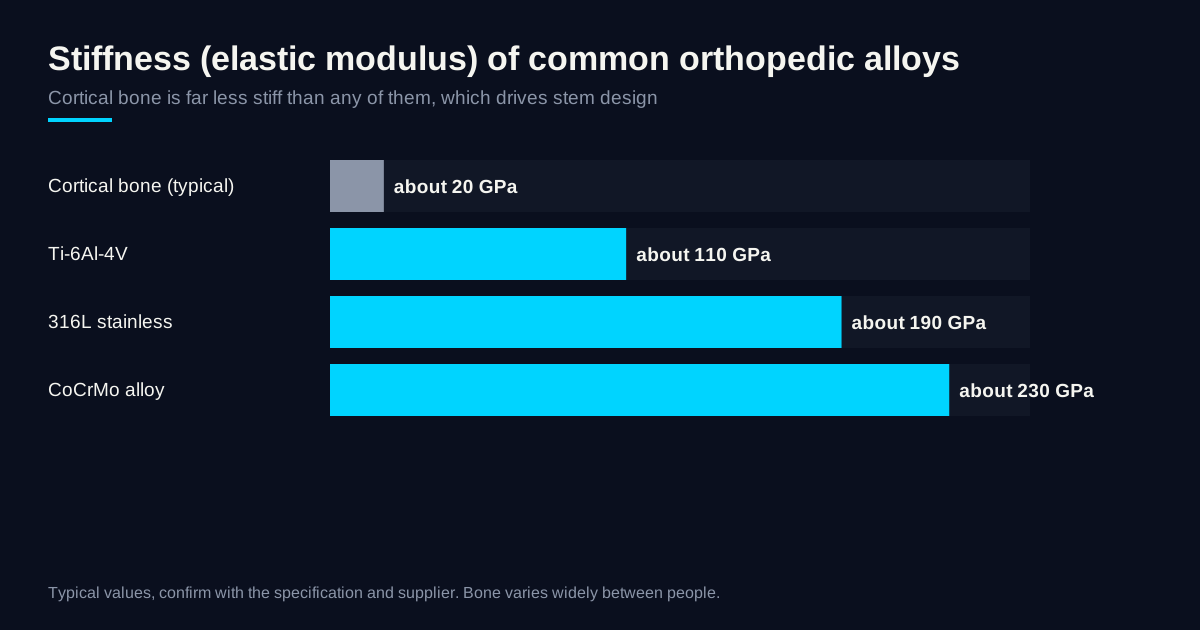
| Elastic modulus | about 210 to 240 GPa | about 110 GPa |
| Hardness | High, often 30 to 45 HRC depending on condition | Lower, about 30 to 36 HRC |
| Wear resistance | Excellent | Poor in sliding contact |
| Fatigue strength | High | High, notch sensitive |
| Bone bonding | Limited without a coating or texture | Good |
| Typical use | Femoral heads, knee condyles, bearing surfaces | Stems, cups, plates, screws, cages |
| Relative cost of material | Higher | Moderate to higher, depends on grade |
Values are typical, vary with processing condition and are not guarantees. Use the figures in the specification that your design names.
Why stiffness matters
The elastic modulus of cortical bone is far below that of either alloy, and a stiff implant carries more of the load than the bone around it. This is the basis of the stress shielding concern in joint replacement. A titanium stem is about half as stiff as a cobalt-chrome stem of the same shape, which is one of the reasons titanium is widely used where a long implant sits inside the bone. Design choices, such as taper, cross section and surface texture, also play major roles, and the decision belongs to the device maker’s engineers.
Wear and bearing surfaces
Where two surfaces slide against each other, as in a hip head against a liner or a knee condyle against a tibial insert, wear resistance and surface finish dominate. Cobalt-chrome can be polished to a very low roughness and keeps it. Titanium alloys tend to gall and wear in sliding contact, so they are not used as bearing surfaces without a surface treatment. This is why a typical joint replacement combines metals: titanium where bone contact and compliance matter, and cobalt-chrome where sliding wear matters.
How they machine
Both alloys are classed as difficult to machine, in different ways.
Cobalt-chrome work hardens quickly, produces high cutting forces and is abrasive to cutting edges. Practical consequences are rigid setups, carbide or ceramic tools with suitable coatings, conservative speeds, steady feeds and no dwell in the cut. Tool life is shorter and cycle times are longer than for titanium, so the part costs more to machine. Grinding is common for final dimensions and for bearing surfaces.
Titanium has low thermal conductivity, so heat concentrates at the tool edge, and its low modulus lets thin parts spring away from the cutter. Sharp tools, high-pressure coolant and constant chip load are the norm. It is easier on tools than cobalt-chrome, but it can gall, and fine chips and dust are a fire hazard, so chip handling matters.
Within the capability window of the partner shops, tolerances of ±0.01 mm are typical and ±0.005 mm a best case on selected features, and these are confirmed per drawing for each material. The capabilities page lists the materials routinely machined.
Cast, forged and wrought: the product form changes the route
Many cobalt-chrome components do not start as bar. A femoral head or a condylar shape can be cast or forged into a near-net blank, then ground and polished. Wrought bar is used for stems and for components that are fully machined. Titanium is mostly machined from bar or forged blanks.
This means that the RFQ must say which form to quote. A casting needs a pattern or die and a foundry, and a forging needs tooling, so the lead time and the minimum quantity change. A shop that quotes machining from bar for a part that the design assumes will be cast is solving a different problem than the one on the drawing.
Finishing routes
- Cobalt-chrome: grinding, lapping and mechanical polishing to a mirror finish on bearing surfaces. Passivation is possible, and electropolishing is a specialist process.
- Titanium: blasting, polishing, anodizing for color coding and sometimes porous or plasma-sprayed coatings for bone ingrowth, which are specialist processes.
Surface requirements on articulating faces are set by the device maker, often as a roughness value and a form tolerance, and a shop’s ability to measure them (profilometer, form measurement) should be confirmed before quoting.
Certificates and traceability
For either alloy, ask for a certificate that names the specification and revision, the heat or lot number, the chemistry and the mechanical properties, and for a traveler that links the heat to the finished parts. For cast parts, the foundry’s heat record and the inspection records of the casting, such as radiography, may be required by the buyer. The quality and documentation page describes the records that normally accompany a lot.
Cost drivers
Cobalt-chrome costs more to buy, more to machine and more in tooling, and the finishing for bearing surfaces adds a further step. Titanium bar can also be expensive, particularly in ELI grade with full documentation. In a quote, the material and cycle time are usually the two largest items, so a change of alloy can alter the price more than any change in tolerance.
Mixed-material assemblies
Joint replacements often combine the two metals in one assembly, for example a titanium stem with a cobalt-chrome head on a tapered junction. The junction becomes a design topic in its own right, because two metals in contact in body fluid raise questions of fretting and corrosion, and the surface finish and the taper tolerance of each mating part matter. These questions are answered through the device maker’s design and testing, not by the machine shop. What the shop can control is the geometry and finish of the taper to the drawing, the cleanliness of the surfaces and the traceability of each part, so a mixed assembly needs clear lot control and separate labeling for each alloy.
Sourcing notes for cobalt-chrome
Bar stock to ASTM F1537 and similar specifications is a specialist product with fewer mills and longer lead times than titanium or stainless, and the bar sizes are limited. For cast parts, the foundry itself needs to be approved by the device maker, and its heat records and inspection results travel with the lot. If the buyer already has an approved foundry or mill, naming it in the RFQ shortens the process. Lead time for the first order should include blank procurement, machining, grinding, polishing, cleaning and inspection, and a prototype run is a sensible way to prove the route on the real material before volume is committed. Ask the shop to state, in the quote, which steps it performs itself and which it outsources.
What the device maker owns
Biocompatibility, ion release, MRI compatibility, wear testing, fatigue testing and the regulatory submission belong to the device maker. The shop machines to the drawing and to the quality requirements on the purchase order, and this site makes no claim of regulatory approval for any shop or process.
A short checklist before you request a quote
- Does the drawing name the alloy by standard and revision, and the product form?
- Is the blank a casting, a forging or bar, and who supplies it?
- Which surfaces need grinding or polishing, and to what value?
- Which certificates and inspection records are required?
- What quantity is planned, and does it justify tooling?
Send the drawing through the RFQ form, and a first response arrives within 24 business hours.