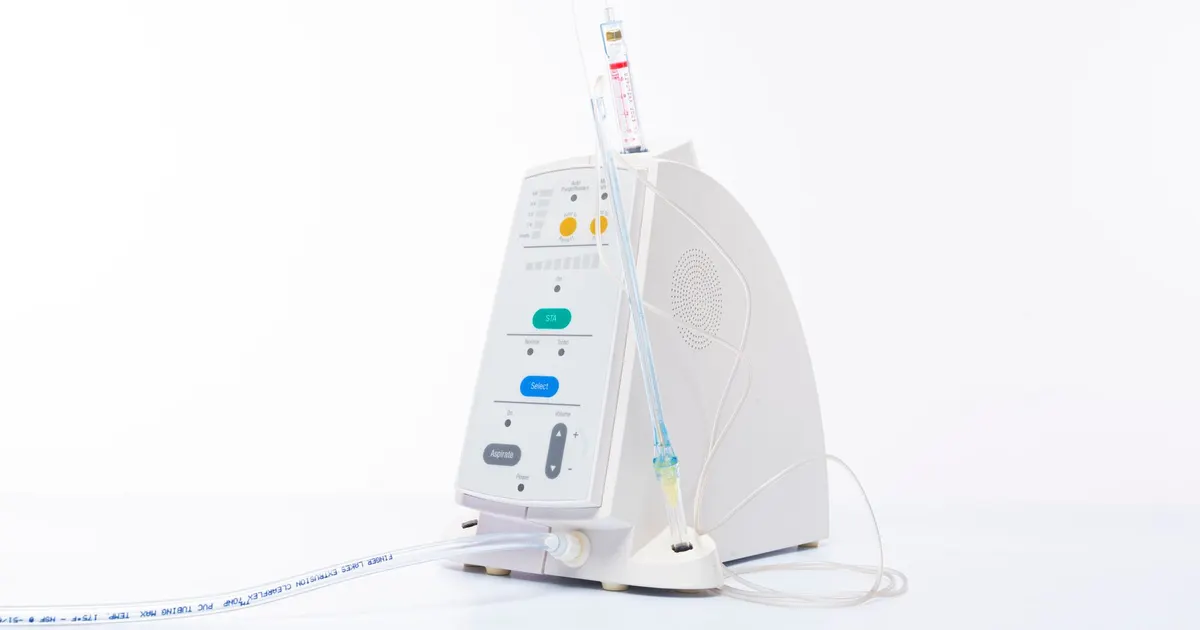
Aluminium is not the first material people think of when they imagine medical hardware, but it is everywhere behind the scenes. It forms the frames of imaging equipment, the housings of monitors and pumps, the bodies of handpieces, the fixtures that hold parts during assembly and test and the cases that carry instrument sets. It is light, it cuts quickly and it takes a durable, attractive finish.
This guide covers what aluminium does well in medical devices, which alloys to use, how anodizing works and changes dimensions, where aluminium should not be used and how to write a drawing that shops can quote accurately. Figures are typical values for the partner shops we match RFQs to in southern Vietnam, confirmed per drawing.
Where aluminium is used
- Equipment housings and frames. Light and stiff, with good thermal conductivity for heat spreading.
- EMI shielding. Unlike plastic, aluminium is conductive, so a machined housing with conductive surfaces forms a shield.
- Handpiece and tool bodies. Where weight in the hand matters, often with an anodized color or texture.
- Fixtures and test jigs. Fast to machine, cheap and stable, which makes them a natural fit for assembly and verification.
- Cases and trays. Anodized aluminium trays and cases are common for carrying instrument sets.
- Optical and sensor mounts. Aluminium holds tight dimensions and is easy to bore and tap.
It is usually not used for implants, and rarely for instruments that are washed repeatedly in alkaline cleaners, for reasons covered below.
Choosing an alloy
| Alloy | Strengths | Limits | Typical use |
|---|---|---|---|
| 6061-T6 | Good strength, machines well, anodizes cleanly, weldable | Medium strength | Housings, frames, fixtures |
| 7075-T6 | High strength | Costlier, lower corrosion resistance, harder to weld | Load-bearing brackets, high-stress fixtures |
| 5052 | Good corrosion resistance, forms well | Sheet and plate only, lower strength | Sheet metal enclosures |
| 2024-T3 or T4 | High strength, fatigue resistance | Lower corrosion resistance, anodizing less uniform | Rarely used in medical |
| Cast alloys such as A380 | Complex shapes in volume | Poor anodizing, porosity | Equipment covers, with a different finish |
For most machined medical housings and fixtures, 6061-T6 is the default. Where the drawing requires a specific standard, for example AMS or ASTM B221 for extrusions, name it, because the temper and the condition affect machining stability and anodizing color.
Machining notes
Aluminium cuts quickly, but a few points decide quality on housings.
- Thin walls. Large housings have thin walls and ribs that spring back and vibrate. Light finishing cuts, sharp tools and good workholding keep flatness.
- Stress. Plate removed unevenly can warp. Stock that is stress relieved or machined symmetrically, with a rest before finishing, holds flatness better.
- Built-up edge. Aluminium can stick to tools. Polished flutes, suitable coatings and coolant prevent it.
- Burrs. Burrs on cross holes and edges must be removed before anodizing, because the coating follows the surface and makes a burr more visible.
- Cosmetic surfaces. Fingerprints, scratches and tool marks show through anodizing. Protect cosmetic faces during machining and handling.
How anodizing works and what it does
Anodizing grows an oxide layer from the aluminium itself in an acid bath. The layer is hard, porous and bonded to the metal, and it can be dyed and sealed. The common types are:
- Thin-film sulfuric anodize, typically a few micrometers, used where dimensions are tight.
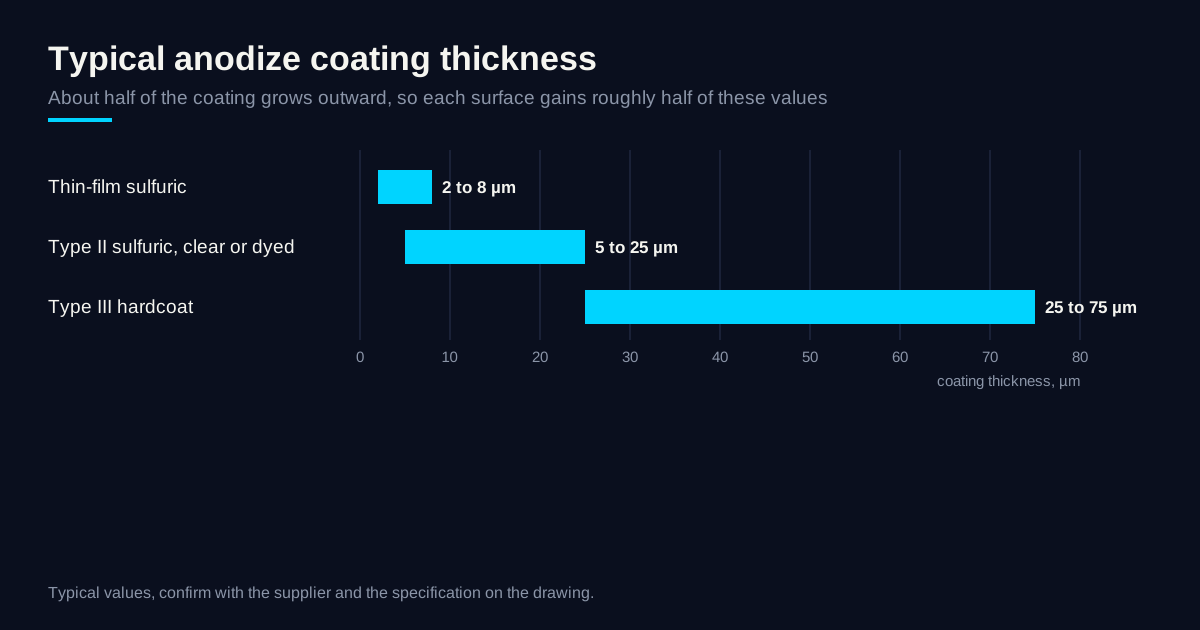
- Type II sulfuric anodize, typically 5 to 25 µm, the standard decorative and protective finish, clear or dyed.
- Type III hardcoat, typically 25 to 75 µm, harder and thicker, used for wear surfaces.
The diagram above shows these typical ranges. The oxide grows about half into the surface and half outward, so each surface gains roughly half of the coating thickness. A 20 µm Type II coating adds about 10 µm per surface, 20 µm on a diameter. A drawing that says “anodize” without a dimension rule leaves the shop to guess, so state whether the tolerance applies before or after coating, and mask or machine critical bores, threads and electrical contact surfaces accordingly. The capabilities page lists anodizing Type II and III among the secondary processes available through the partner shops.
Color, sealing and appearance
Dyes give color coding and branding. Black anodize is common on equipment and optical parts. Color match from lot to lot depends on the alloy, the bath and the dye lot, and clear aluminium from different mills can look different after anodizing. For cosmetic parts, agree an approved sample and a color tolerance. Sealing closes the pores and improves corrosion resistance and color stability. Dyed and sealed coatings can fade under strong light and some disinfectants, which matters for parts that are wiped many times a day.
Threads, inserts and joining
Aluminium threads are softer than steel threads and wear out if a screw is removed many times. Where a fastener will be assembled and serviced repeatedly, designers fit threaded inserts, such as helical or solid bushings made of stainless steel, into the aluminium. The hole for an insert has its own tolerance and depth, and it should be shown on the drawing. Tapped holes in anodized parts are normally masked or tapped after coating, and the thread class should be stated for the finished condition.
Welding is possible for 6061 and 5052 but changes the temper near the weld, so a welded housing usually needs a machining allowance and sometimes a re-heat-treatment. Adhesive bonding and press-fit pins are common alternatives for enclosures. Whatever the method, review it with the shop before the drawing is frozen, since the choice affects cost more than the alloy does.
Finishes other than anodizing
Not every aluminium part is anodized. Bead blasting gives a uniform matte surface that hides tool marks and fingerprints. Brushed and satin finishes are produced by abrasive belts or media. Chemical conversion coatings protect fixtures and internal parts at low cost, and powder coating is used on larger equipment covers. Each finish has its own thickness, appearance and cleaning behavior. For a cosmetic part, the finish sequence matters: for example, blasting before anodizing gives a different look than anodizing after polishing. State the sequence, the texture and an approved sample on the drawing.
Conductivity, grounding and EMI
Anodize is an insulator. A housing that must carry current, ground the equipment or shield against electromagnetic interference needs bare or conductively coated areas. The common approaches are to mask the contact surfaces during anodizing or to use a conductive conversion coating on the whole part. Conversion coatings based on chromium have environmental restrictions, so many designs now call for trivalent chromium types. Check the restrictions that apply to the product’s market, and specify the coating by standard on the drawing.
Cleaning, disinfection and corrosion
This is where aluminium needs the most care. Many hospital detergents are alkaline, and alkaline solutions dissolve aluminium oxide and attack the metal, causing staining, pitting and loss of anodize. Hot cycles make it worse. For that reason aluminium is a poor choice for instruments that go through washer-disinfectors with strongly alkaline detergents.
Equipment housings that are wiped with disinfectant are a different case, and anodized aluminium is widely used. What matters is that the disinfectants on the product’s cleaning instructions are tested against the finished surface. The device maker defines the cleaning agents and validates the result. Neither the shop nor this sourcing service makes cleaning or sterilization claims.
Aluminium in imaging environments
Aluminium is non-ferromagnetic, which makes it a common material near magnetic resonance equipment. It is not magnetically invisible, however, because it is a good conductor and eddy currents can form in a changing field. Whether a part is acceptable in a given environment is decided by the device maker through its own testing and labeling.
Writing the drawing
- Name the alloy, temper and standard, for example 6061-T6 to the specification of your choice.
- State the coating by type and thickness range, and whether dimensions apply before or after.
- List the masked surfaces, for threads, bores, grounding points and contact faces.
- Describe the cosmetic requirement, including which faces are visible and the acceptance sample.
- Say how parts are to be cleaned and packed, since fingerprints and oil show on anodized surfaces.
- Add flatness or form tolerances for thin walls, with a measurement method.
A short checklist before you request a quote
- Does the part really need aluminium, given the cleaning agents it will meet?
- Is the alloy and temper right for strength, finish and weldability?
- Do critical dimensions allow for coating growth?
- Are conductive areas defined?
- Has a cosmetic standard been agreed?
Send the drawing through the RFQ form, and a first response arrives within 24 business hours. The device maker remains responsible for material selection, cleaning validation, electromagnetic compatibility and every regulatory submission. The quality and documentation page lists the process records available with each lot.
See also: IEC 60601-1 and machined housings for the enclosure topics that reach the drawing.