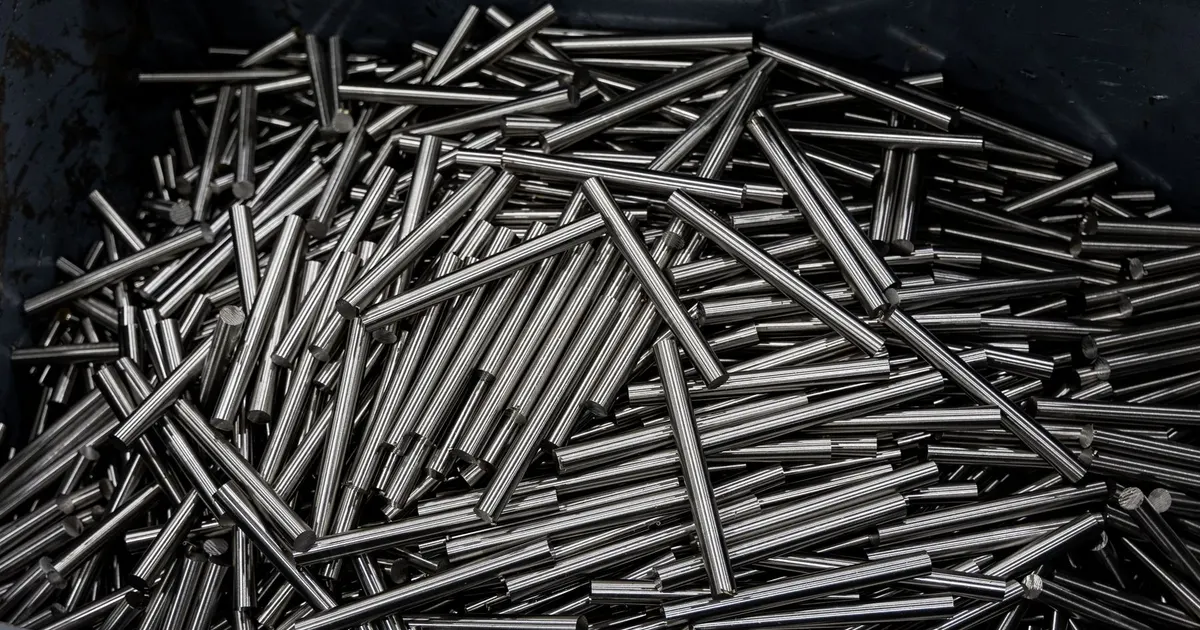
Stainless 316L is everywhere in medical devices. It is used in instruments, housings, fixtures and implants, and most buyers think of it as one material. Drawings for implantable parts and for fine, fatigue-loaded features often say 316LVM instead, and the extra letters change the price, the lead time and the paperwork. This guide explains what the V and M mean, which standards are usually behind them, how the material machines and polishes and how to decide whether a part needs the vacuum-melted grade.
The partner shops we match RFQs to in southern Vietnam machine 316L and, where the bar can be sourced with the right certificate, 316LVM. Availability and lead time are confirmed per RFQ. The device maker owns the material choice, and the sourcing service does not recommend a grade for a particular device.
What the letters mean
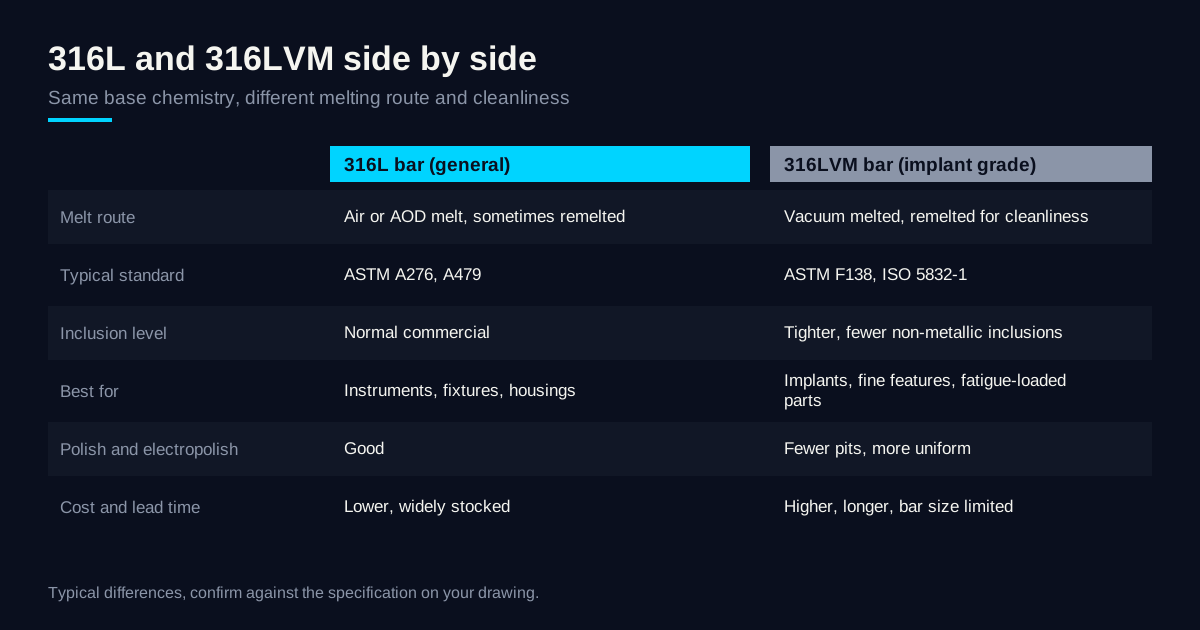
316L is an austenitic stainless steel with about 16 to 18 percent chromium, 10 to 14 percent nickel and 2 to 3 percent molybdenum, with a low carbon limit so that it resists sensitization in welding. The VM stands for vacuum melted. The steel is melted in a vacuum induction furnace and then remelted, usually in a vacuum arc remelting furnace, which refines it a second time.
The aim of the process is cleanliness. Ordinary melting leaves small non-metallic inclusions, such as oxides and sulfides, scattered through the steel. Vacuum processing removes dissolved gases and lowers the number and size of these inclusions. The chemistry on the certificate looks almost identical to standard 316L, but the internal quality of the bar is very different.
Why cleanliness matters for medical parts
Inclusions are invisible on the drawing and critical in use. They matter in four places.
- Fatigue. A crack starts at a defect, and an inclusion near the surface is a defect. Cleaner steel gives more consistent fatigue performance, which is why it is preferred for load-bearing implants and fixation hardware.
- Fine features. Thin walls, small holes and fine threads can intersect an inclusion and break out, leaving a pit or a tear.
- Polished and electropolished surfaces. An inclusion at the surface leaves a pit when the surrounding steel is polished or electropolished, which shows up as a defect on a mirror finish.
- Corrosion. Sulfide inclusions are known starting points for pitting in some environments. Fewer of them lowers the risk.
None of this is a guarantee, and the device maker’s risk analysis decides the requirement. The point is that the vacuum grade is purchased for internal quality, not for a different alloy.
Standards you will see on drawings
| Standard | What it covers | Typical use |
|---|---|---|
| ASTM F138 | Wrought 18Cr-14Ni-2.5Mo stainless steel bar and wire for surgical implants (UNS S31673) | Implant bar stock |
| ISO 5832-1 | Wrought stainless steel for surgical implants | Implants, international specifications |
| ASTM A276 and A479 | General stainless bar and shapes | Instruments, fixtures, housings |
| ASTM F899 | Wrought stainless steels for surgical instruments | Instrument bodies |
The exact requirements for melting, microstructure and inclusion rating are in the text of the standard and its revision. A drawing that says only 316L is ambiguous for an implant. It should name the specification, and the purchase order and the certificate should match.
How 316LVM machines
Austenitic stainless steels share a set of habits. They work harden, so a dull tool or a dwell in the cut makes the surface harder than the bulk. They conduct heat poorly, so the edge runs hot. They are tough and produce long, stringy chips that tangle around the tool and the part.
316LVM adds one more habit. Standard 316L usually has a small amount of sulfur, and sulfides help chips break. The vacuum grade has very low sulfur, so chips are longer and chip control needs extra care. Good practice includes:
- sharp, positive-rake inserts with a polished or low-friction coating,
- chip breakers matched to the depth of cut, and a steady feed, since light, rubbing cuts work harden the surface,
- high-pressure coolant directed at the edge, which also helps chip evacuation,
- conservative tool life, replacing tools before they dull, because dull tools lift burrs and rough the finish,
- firm workholding, since austenitic bar springs away from a light tool.
Speeds and feeds are close to those for 316L. The difference shows up in chip handling and in finishing, not in the basic process.
Finishing a cleaner material
Because there are fewer inclusions, 316LVM generally gives a more uniform polished or electropolished surface and fewer pits. That is a reason to choose it when the drawing demands a mirror finish on a small part. It does not remove the need for a good machined finish first, and the electropolish allowance has to be planned. The article on electropolishing in our guides section covers the process, and the capabilities page lists the finishing processes available through the partner shops.
Passivation is normally specified under ASTM A967, and the surface must be free of embedded iron from tools and fixtures. Dedicated stainless tooling and clean workholding reduce this risk.
Certificates and traceability
The certificate is what makes a bar 316LVM. Ask for:
- a mill certificate that names the specification and revision, for example ASTM F138, and the melt route,
- the heat number, chemistry, mechanical properties and any inclusion rating that the standard requires,
- a traveler that links the heat number to every part in the lot,
- a certificate of conformance from the shop that references the drawing revision.
A bar without a matching certificate must not be used for implant parts, even if it looks identical. If there is any doubt, a laboratory analysis of a sample is an inexpensive check, although it confirms chemistry and not the melt route. Positive material identification with a handheld analyzer can separate 316L from other alloys, but it cannot prove vacuum melting. The quality and documentation page describes the records that normally accompany a lot.
Condition, nickel and magnetism
Implant bar is supplied in defined conditions, such as annealed or cold worked, and the condition changes strength and machining behavior. Cold-worked bar is stronger and cuts with less smearing, but it can move more when material is removed from one side. The drawing should state the condition, or the specification and its condition code.
Two questions come up often with 316LVM. The first is nickel. The alloy contains a substantial amount of it, and nickel sensitivity is a known concern for some patients. Whether that matters for a given implant is a biocompatibility question owned by the device maker, usually answered with testing under the ISO 10993 series, and not something a shop can decide. The second is magnetism. Fully annealed austenitic steel is essentially non-magnetic, but heavy cold working and machining can create a weak magnetic response in the surface layer. If an MRI-related requirement applies, the device maker states it, and the shop should be told which test is expected.
Cost, size range and lead time
316LVM costs more than standard 316L, since it needs more refining steps and more testing. The premium and the lead time depend on bar diameter, quantity and supplier. Small diameters, which many medical parts use, are widely available from specialist mills but are often imported into Southeast Asia, so lead times can run to weeks. For small orders, a minimum bar quantity may exceed what the parts need. Raise the question of stock and lead time at the RFQ stage, and consider whether the drawing really requires the vacuum grade for every part in the assembly.
When 316L is enough
Many instrument bodies, fixtures, trays and housings do not enter the body and do not carry cyclic loads in the same way. For these parts, the drawing may allow standard 316L to ASTM A276 or A479. Using the vacuum grade where it is not required adds cost without benefit, while using standard grade where the specification demands the vacuum grade is a serious nonconformance. The decision rests with the device maker, and the way to make it safe is to put the specification on the drawing.
A short checklist before you request a quote
- Does the drawing name the specification and revision, such as ASTM F138, or only 316L?
- Is the part an implant, an instrument or a fixture?
- Which certificates and tests are required with each lot?
- What finishing applies, and does the surface need to be pit-free after electropolish?
- What quantity is needed, and what is the minimum bar quantity?
Send the drawing through the RFQ form, and the first response, including material availability and design for manufacturing feedback, arrives within 24 business hours. The device maker remains responsible for material selection, biocompatibility, validation and every regulatory submission.