A medical device maker controls the parts it buys through its quality system, and the rules that shape that system are the same ones a machined component supplier is audited against: ISO 13485 as the quality standard, the FDA Quality Management System Regulation (QMSR) in the United States, the accreditation chain behind any certificate, and the device records that the supplier feeds. This page maps those pieces to each other and to the detail pages. As of October 2026 ISO 13485:2016 is the current edition and the QMSR has been in force since 2 February 2026.
| Piece | What it is | Who it binds | Document a supplier is asked for |
|---|---|---|---|
| ISO 13485:2016 | Quality management system standard for medical devices | Voluntary. Referenced by regulators and customers | Certificate, or audit report and quality manual |
| FDA QMSR (21 CFR 820) | US rule that incorporates ISO 13485 | Finished device manufacturers. Not component makers | Supplier agreement, records, audit access |
| Accreditation chain | Certification body, accreditation body, international arrangement | Certification bodies and accreditation bodies | Certificate number, body name, accreditation scope |
| MDSAP | Single audit program recognized by five regulators | Voluntary for device manufacturers | MDSAP certificate, where a manufacturer holds one |
| EU notified body certificate | Conformity assessment under the EU medical device regulations | Manufacturers placing devices on the EU market | Not asked of a component shop in the usual case |
| Device records | Medical device file, batch record, design and development file | Device maker, with supplier input | Certificate of conformance, material certificates, inspection data |
Industry by standards matrix
| Industry or product | Product standards (layer A) | Certifications (layer B) | Tests and documents (layer C) | Market rules (layer D) |
|---|---|---|---|---|
| Equipment housings, imaging and monitoring | IEC 60601-1 enclosure requirements, IP rating | ISO 13485 at the device maker, ISO 9001 or 13485 at the shop | Certificate of conformance, first article, roughness | RoHS and REACH for equipment, customs classification |
| Drug delivery and infusion parts | ISO 80369 small-bore connectors, USP class VI resins | ISO 13485 | Cleanliness, biocompatibility reports, lot traceability | FDA QMSR, EU medical device regulations, Vietnam medical device rules (check) |
| Respiratory and ventilator parts | ISO 80369-2 respiratory connectors, ISO 5356-1 and ISO 18562 (check parts and editions) | ISO 13485 | Cleanliness, leak, certificate of conformance | EU and US device rules |
| Dental handpieces and ophthalmic | ISO 14457 (check) | ISO 13485 | Roughness, autoclave durability | Export lanes |
| Sterilization trays and hospital beds | EN 868-8 and AAMI ST77, IEC 60601-2-52 (check) | ISO 9001 or 13485 | Certificate of conformance, weld and finish records | RoHS, tariffs |
Cells marked check have not been verified for this page and are listed as starting points.
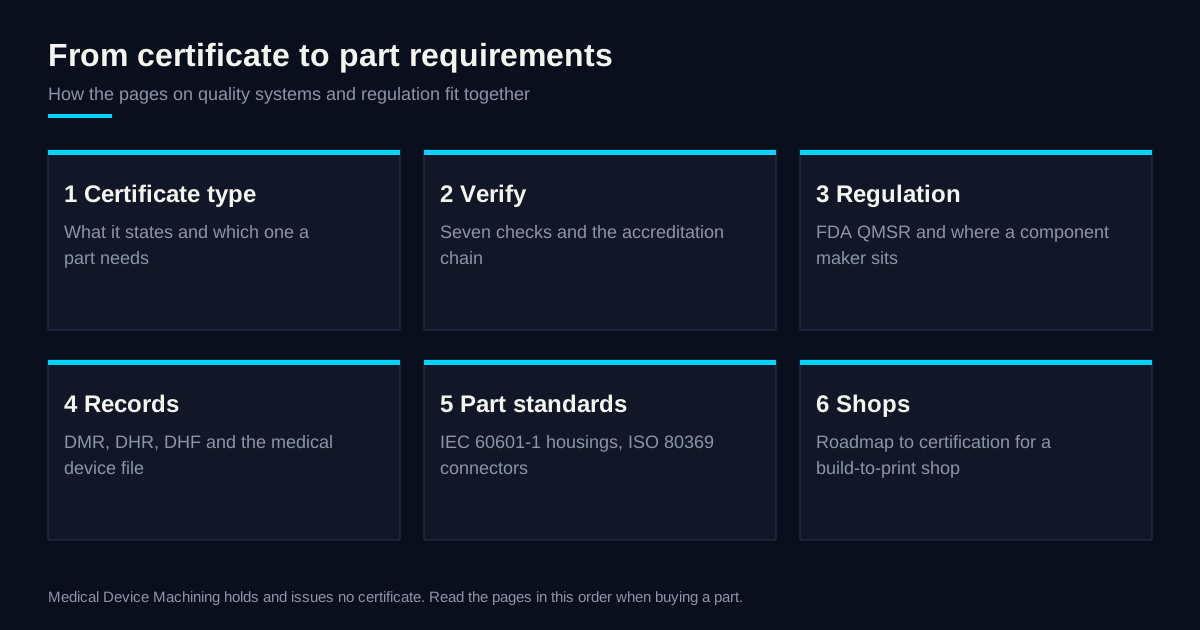
How the pages fit together
- Choose the certificate type. ISO 13485 certification explained covers what the certificate states, and ISO 13485 vs ISO 9001 covers which one a given part calls for.
- Check the one a supplier sends. How to verify an ISO 13485 certificate gives seven checks, and certification bodies and accreditation explains the chain behind a certificate.
- Place it in the regulation. FDA QMSR explained shows how 21 CFR 820 uses ISO 13485 and where a component maker sits.
- Fix the records. DMR, DHR, DHF and MDF maps legacy record names to current ones and lists what a shop supplies.
- Write the part requirements. Product standard pages such as IEC 60601-1 for housings and ISO 80369 connectors show what lands on a drawing.
- For shops. The Vietnam machine shop roadmap and the Vietnamese guide chứng nhận ISO 13485 cho xưởng cơ khí cover the steps to certification.
Questions to settle before you order
| Question | Why it matters | Where to look |
|---|---|---|
| Does the part go into an implant, a reusable instrument or equipment? | Risk decides how much supplier evidence the device maker needs | ISO 13485 vs ISO 9001 |
| Which certificate does your quality agreement name, and which edition? | A requirement that says ISO 9001 or ISO 13485 without an edition can be read two ways | ISO 13485 certification explained |
| Is the certificate real and does its scope cover this part and this site? | A valid number for a different site or activity proves nothing about your part | How to verify an ISO 13485 certificate |
| Which records will the shop ship with each lot, and for how long will it keep the originals? | These feed the device maker’s files under the current record vocabulary | DMR, DHR, DHF and MDF |
| Which product standard and edition does the drawing rely on? | Several of them changed in 2024 to 2026 | ISO 80369 connectors |
What changed recently
| Date | Change | Effect on a supplier |
|---|---|---|
| 2 February 2026 | FDA QMSR took effect | Customers’ supplier agreements move to ISO 13485 vocabulary |
| 1 January 2026 | IAF and ILAC replaced by Global Accreditation Cooperation Incorporated | Names of arrangements and marks change, accreditations stay recognized |
| January 2026 | ISO 13485:2016 reconfirmed, reported valid without revision until April 2030 | No new edition to plan around yet |
| 16 September 2026 | ISO 9001:2026 published, transition to 30 September 2029 | A customer’s ISO 9001 requirement should name the edition |
| 2024 and 2025 | ISO 80369 parts 1, 2 and 6 issued in new editions | Connector drawings must cite the part and edition |
Limits of these pages
We hold no certificate and we do not certify, audit or register anyone. The pages are general information as of October 2026 and not legal or regulatory advice: confirm requirements with your regulatory counsel, notified body or regulator. The device maker stays responsible for regulatory compliance of its devices.
To discuss a part, send an RFQ. We reply within 24 business hours. For the existing record and documentation guidance, see quality and documentation.